

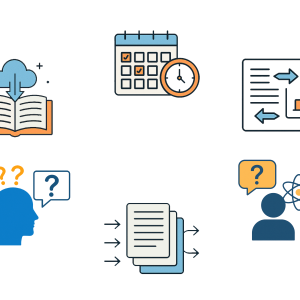
Study Strategies That Work
To really learn the material it's not always about how much time you put in, it’s about how you use that time. Research shows that certain strategies can make learning stick longer and help you perform better on exams and assignments. The techniques below are all proven ways to move information into long-term memory and...Continue reading→

Self Explanation
What it is Self-explanation is the practice of pausing while you study to explain the material, either to yourself or someone else. You want to use your own words to talk through what the concept or idea means, how it works, or how you would teach it to someone else. Why it matters Explaining in...Continue reading→

Elaborative Interrogation
What Is Elaborative Interrogation? Elaborative interrogation a strategy that leverages questions and curiosity. Instead of just taking information at face value, you ask questions and seek answers to why it’s true or why it is happening, or how it connects to what you already know. Consider the difference between the statement “Important principles of chemistry”...Continue reading→

Spaced Practice
What is Distributed or Spaced Practice? Distributed practice - or Spacing - is a technique commonly used when learning material or studying for a test. It involves creating a schedule of study sessions of short duration. These should be used to practice the same material - not new material. Distributed practice can be contrasted to...

Retrieval Practice
What is Retrieval Practice? Retrieval practice is the active process of trying to recall concepts and big ideas, even before we completely know our material. Instead of simply glancing over our notes, or passively underlining key words, retrieval practice engages a deep effort that strengthens recall to the point where it creates strong, long-term retention....Continue reading→

Interleaving
What is Interleaving? Interleaving is a learning technique where you purposefully mix up the topics you are reviewing and practicing within one study session. It is meant to replace blocked practice, where you only work on one topic for an extended period - such only practicing your multiplication tables while studying for math. Switching between...Continue reading→

Dual Coding
What is Dual Coding? Ever spend hours reading or studying, only to forget most of it the next day? Dual coding can help. This study strategy uses two forms of input — verbal (text or speech) and visual (images, diagrams, charts) — to help you understand and remember information more effectively. By engaging both the...
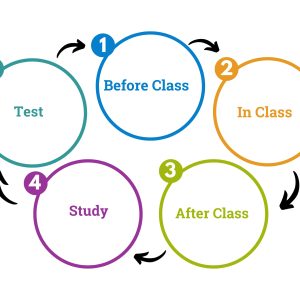
The Study Cycle
The study cycle is a guide to help you distribute your studying so you aren’t doing it all at once at the last minute, and to reinforce your learning from one step to the next. Download PDF: The Study Cycle
